Menu

 EUR
EUR CAD
CAD AUD
AUD GBP
GBP MXN
MXN HKD
HKD CNY
CNY MYR
MYR SEK
SEK SGD
SGD CHF
CHF THB
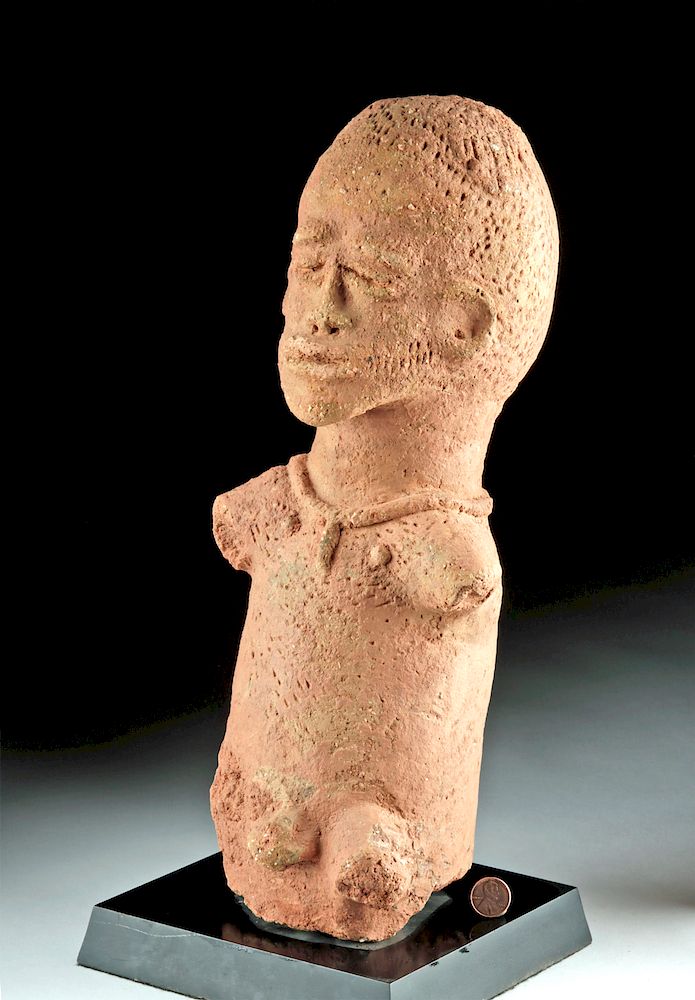
THBWest African Sokoto Terracotta Shrine Figure w/ TL
Lot 193a



About Seller

Artemis Fine Arts
686 S Taylor Ave, Ste 106
Louisville, CO 80027
United States
Selling antiquities, ancient and ethnographic art online since 1993, Artemis Gallery specializes in Classical Antiquities (Egyptian, Greek, Roman, Near Eastern), Asian, Pre-Columbian, African / Tribal / Oceanographic art. Our extensive inventory includes pottery, stone, metal, wood, glass and textil...Read more
 Live Auction in Progress ... Currently on Lot
 Estimate:
$900 - $1,400
Absentee vs Live bid
Two ways to bid:
- Leave a max absentee bid and the platform will bid on your behalf up to your maximum bid during the live auction.
- Bid live during the auction and your bids will be submitted real-time to the auctioneer.
Bid Increments
| Price | Bid Increment |
|---|---|
| $0 | $25 |
| $300 | $50 |
| $1,000 | $100 |
| $2,000 | $250 |
| $5,000 | $500 |
| $10,000 | $1,000 |
| $20,000 | $2,500 |
| $50,000 | $5,000 |
| $100,000 | $10,000 |
| $200,000 | $20,000 |
About Auction
 Live
Live
By Artemis Fine Arts
Apr 25, 2019
Set Reminder
2019-04-25 10:00:00
2019-04-25 10:00:00
America/New_York
Bidsquare
Bidsquare : Pre-Columbian | Tribal | Ethnographic
https://www.bidsquare.com/auctions/artemis-gallery/pre-columbian-tribal-ethnographic-4035
Featuring ancient and ethnographic art from around the world, including Pre-Columbian, Native American, African / Tribal, Ethnographic, Spanish Colonial, Fossils, Fine Art, much more. Artemis Fine Arts info@artemisfinearts.com
Featuring ancient and ethnographic art from around the world, including Pre-Columbian, Native American, African / Tribal, Ethnographic, Spanish Colonial, Fossils, Fine Art, much more. Artemis Fine Arts info@artemisfinearts.com
 View Full Catalog (415)
- Lot Description
West Africa, modern day Nigeria, Sokoto culture, ca. 500 BCE to 200 CE. A fascinating hollow terracotta shrine figure or anthropomorphic form, with the head larger proportionally than the rest. It is a male figure wearing a necklace and with elaborately braided hair. Sokoto state in modern day northwest Nigeria is in the Niger River Valley, at the confluence of ancient trade routes and roughly contemporary with the Nok culture to its south. Very little is known of the ancient Sokoto culture; Bayard Rustin (yes that one!), who originally collected the Sokoto collection for the Yale University Art Gallery, recorded that most terracotta pieces like this one were found in large manmade mounds. Characteristic Sokoto figures are large, hollow, thin-walled, and low-fired human figures with heavy eyebrows and beards. Size: 6.7" L x 6.3" W x 15.5" H (17 cm x 16 cm x 39.4 cm); 16.25" H (41.3 cm) on included custom stand.
This piece has been tested using thermoluminescence (TL) analysis and has been found to be ancient and of the period stated. A full report will accompany purchase.
Provenance: ex-private Pearson collection, Denver, Colorado, USA; ex-Peter Arnovick collection, San Francisco, California, USA
All items legal to buy/sell under U.S. Statute covering cultural patrimony Code 2600, CHAPTER 14, and are guaranteed to be as described or your money back.
A Certificate of Authenticity will accompany all winning bids.
We ship worldwide and handle all shipping in-house for your convenience.
#145051The arms are lost at the ends as is one foot. There are two small holes on the body.Condition
- Shipping Info
-
All shipping is handled in-house for your convenience. Your invoice from Artemis Gallery will include shipping calculation instructions. If in doubt, please inquire BEFORE bidding for estimated shipping costs for individual items.
-
- Buyer's Premium