Menu

 EUR
EUR CAD
CAD AUD
AUD GBP
GBP MXN
MXN HKD
HKD CNY
CNY MYR
MYR SEK
SEK SGD
SGD CHF
CHF THB
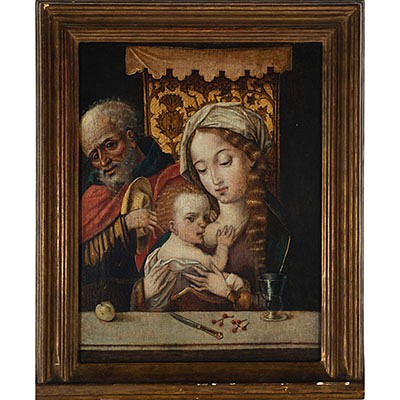
THBExceptional Holy Family with flower garland, attributed to Gaspar Pieter Verbruggen and possibly Cornelius Schut, flemish school of the 17th century
Lot 175



 Live Auction in Progress ... Currently on Lot
 Estimate:
EUR€30,000 - EUR€40,000
$34,883.72 - $46,511.63
Absentee vs Live bid
Two ways to bid:
- Leave a max absentee bid and the platform will bid on your behalf up to your maximum bid during the live auction.
- Bid live during the auction and your bids will be submitted real-time to the auctioneer.
Bid Increments
| Price | Bid Increment |
|---|---|
| EUR€0 | EUR€10 |
| EUR€50 | EUR€10 |
| EUR€100 | EUR€20 |
| EUR€200 | EUR€25 |
| EUR€500 | EUR€50 |
| EUR€1,000 | EUR€100 |
| EUR€2,000 | EUR€250 |
| EUR€5,000 | EUR€500 |
| EUR€10,000 | EUR€1,000 |
| EUR€20,000 | EUR€2,500 |
| EUR€50,000 | EUR€5,000 |
| EUR€100,000 | EUR€10,000 |
| EUR€200,000 | EUR€25,000 |
| EUR€500,000 | EUR€50,000 |
About Auction
 Live
Live
By Templum Fine Art Auctions
Feb 24, 2022
Set Reminder
2022-02-24 11:00:00
2022-02-24 11:00:00
America/New_York
Bidsquare
Bidsquare : Antiques Fine Art, Including African Art
https://www.bidsquare.com/auctions/templum-fine-art-auctions/antiques-fine-art-including-african-art-8912
Antiques, African art, decorative art, collections, sculptures Templum Fine Art Auctions info@templumauctions.com
Antiques, African art, decorative art, collections, sculptures Templum Fine Art Auctions info@templumauctions.com
 View Full Catalog (388)
- Lot Description
Oil on canvas. Measurements: 135 x 166 cm. Provenance: important private collection, North of Spain. Gaspar Peeter Verbruggen (I) (Antwerp, 1635-1681) was one of the most outstanding Flemish Baroque painters specializing in the painting of flower garlands and vases. Baptized in Antwerp on September 8, 1635, he was a disciple of Cornelis Mahu, in whose workshop he is recorded as early as 1644-1645, when he was only ten years old. Married to Catharina de Zeverdonck, who died in 1674, and secondly to Sara Catharina Raeps, at her death he left behind six living minor children, the eldest, Anna, aged 23. A member of the Saint Luke guild since 1650, he may have collaborated on occasion with Frans Ykens. His floral still lifes, dated from 1654 to 1680, like those of his son and his disciple Gaspar Peeter Verbruggen the Younger (1664-1730), they represent an Italianate current within Antwerp flower painting, in the baroque manner of Abraham Brueghel. Likewise, Cornelis Schut (Antwerp, May 13, 1597 - April 29, 1655) was a Flemish painter, draftsman and engraver. In 1618 he entered the painters' guild of his native town. His early works show clear influences from the style of Abraham Janssens, of whom he was probably a disciple. In 1624 he moved to Italy where he remained until 1628. In Rome he worked for the collector Vincenzo Giustiniani who became his protector and for whom he painted The Massacre of the Innocents (Museum of Fine Arts, Caen, France). Later in 1628 he moved to Florence, where he made different designs for tapestries for the Medicea Factory. During his stay in Italy he painted mostly mythological and religious subjects, as well as frescoes and was influenced by the Roman Baroque style of Guercino and Pietro da Cortona and the Baroque classicism represented by Domenichino and Guido Reni. Upon his return to Antwerp he carried out some works together with Rubens, such as the ephemeral decorations for the reception of Cardinal-Infante Ferdinand of Austria (1635), although there is no evidence that he worked in his workshop. He painted religious works for important private collectors, the Church and numerous monasteries, such as the Assumption of the Virgin (1645-1647). His work achieved great diffusion, being frequently reproduced in engravings throughout Europe and the New World. Reference bibliography: Vlieghe, Hans, Flemish art and architecture, 1585-1700, Madrid, C‡tedra, 2000, ISBN 84-376-1842-8 Jane Turner (Editor). Grove Dictionary of Art (1996, 34 vols.). ISBN 1-884446-00-0
- Shipping Info
-
For the delivery of the lots: _It is possible to pick them up in person in Roselló 193. _We can send you shipping company contacts to fix it on your own. _You can send us an email asking for a shipping quote, and we will arrange it
-
- Buyer's Premium